DOLCE FAR NIENTE: A PRACTICE, NOT A VACATION
There's a phrase Italians use that doesn't translate well, and I think that's the point.
Dolce far niente. The sweetness of doing nothing. It sounds like a vacation. It sounds like something you earn after a long week, or save for a certain kind of afternoon in a certain kind of place. But I've come to think that's exactly the wrong way to understand it.
Dolce far niente is not a reward. It's a practice.
WHAT IT ACTUALLY MEANS
Doing nothing, in the Italian sense, is not the absence of activity. It's the presence of ease. It's the cup of coffee you drink slowly, standing at the bar, without checking your phone. It's the walk you take with no destination. It's the hour after lunch that belongs to no one and nothing in particular.
It's not laziness. Laziness is when you don't do something you should. Dolce far niente is when you do nothing because that, for now, is exactly the right thing to do.
The distinction matters because most of us are very good at doing nothing badly. We scroll. We half-watch. We rest with one eye on the clock. That's not dolce far niente. That's just being tired without permission.
WHY IT'S HARDER THAN IT SOUNDS
When I lived in Italy, I thought I understood this concept. I had it around me every day — in the way people lingered over lunch, in the unhurried quality of a Sunday morning, in the fact that nobody apologised for sitting still.
Then I moved to Sri Lanka, and I understood it differently.
Here, slowness is not cultural permission. It's the climate, the light, the rhythm of the place. By four in the afternoon, the heat asks you to stop. The ocean at dusk asks you to watch. There is no ambient pressure to be productive. Nobody is racing anywhere in particular.
And I realised: I had to learn it again. Not because I'd forgotten it, but because I'd been doing it on vacation — which is easy — rather than as a way of living, which is something else entirely.
Dolce far niente as a vacation mode is passive. You fall into it because the circumstances allow. Dolce far niente as a practice is a small, daily act of choosing rest before you need it, beauty before you've earned it, stillness before the noise asks for it.
WHAT THE PRACTICE ACTUALLY LOOKS LIKE
It doesn't require a beach or a particular latitude. It requires attention, which is harder but more portable.
A few things that have made it real for us:
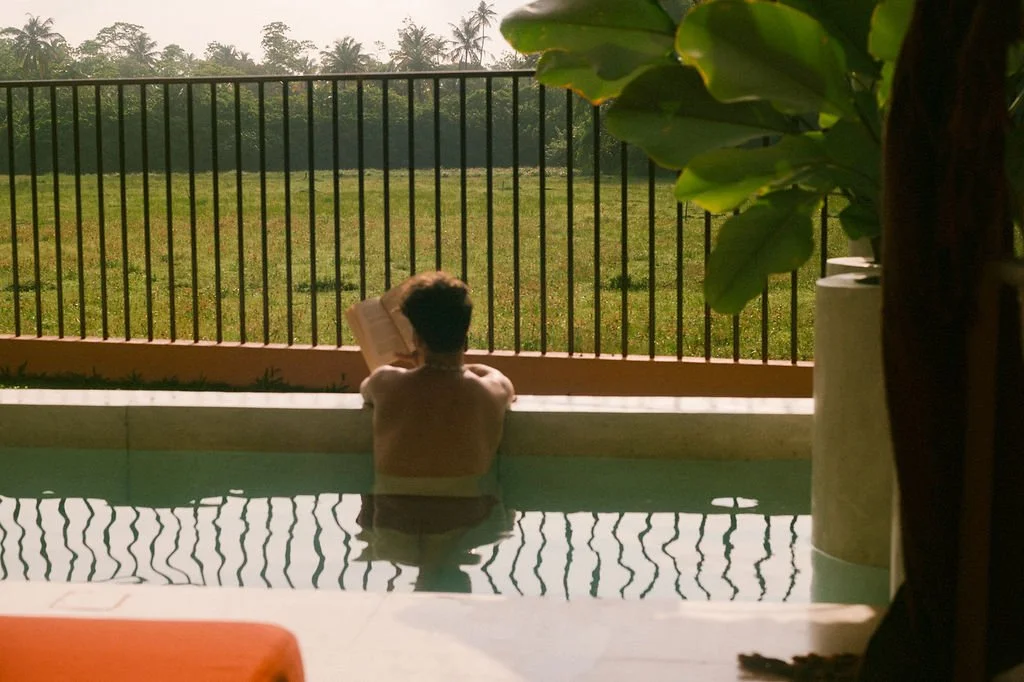
One hour with no agenda. Not scheduled, not earned, not explained. Just an hour that belongs to whatever happens to be in front of you — a book, a garden, a cup of something warm. The rule is only that you don't fill it.
A meal without multitasking. Not every meal, but one a day. No phone on the table. No catching up on something while you eat. Just the food, the person across from you, and whatever conversation arrives naturally. It sounds obvious. It is not easy.
The walk that goes nowhere. Not exercise. Not a podcast. Just movement with your eyes open. The sweetness of doing nothing often arrives when your hands are free and your feet are moving and there's no particular place to be.
Watching the light change. This one costs nothing. Sunrise, sunset, the particular quality of late afternoon light on a white wall. Learning to notice it, even briefly, is a form of practice.
WHY IT MATTERS MORE THAN WE THINK
We live in a culture that treats rest as recovery. You rest so you can go again. You slow down so you can speed up. Even our idea of a good vacation is often about how refreshed you'll be when you return.
Dolce far niente offers something different: the idea that ease has value in itself. That a morning where nothing was accomplished can still be a good morning. That presence, without output, is not wasted time.
This is what five years in Sri Lanka have quietly taught me. Not how to do nothing — I knew that already. But how to mean it.
Casa Tikiri was built around this feeling: that the best thing we can offer someone is a place where they remember how to stop. But you don't need to travel for that. You just need to start smaller, and closer, and now.
The coffee is getting cold. Put the phone down.